
The Difference Between a Daycare and an Early Learning Center
For families in Norwood, choosing care for a young child often starts with a practical question: daycare or early learning center? Both can provide supervision and a safe place for children while parents work, but the terms can suggest different priorities when it comes to curriculum, developmental goals, classroom structure, and preparation for kindergarten.
Quick answer: A daycare generally emphasizes dependable child care and daily routines, while an early learning center typically places additional emphasis on intentional, age-appropriate learning and development throughout the day. The distinction is not determined by the name alone, however. Norwood parents should compare each program’s teachers, curriculum, routines, communication, environment, and approach to development before deciding which setting fits their child.
What local families should know
The words “daycare” and “early learning center” do not tell parents everything about the quality or educational approach of a program.
Families in Norwood should look closely at how play, routines, teacher interaction, and planned activities support development.
Massachusetts families can ask how a center’s curriculum relates to state early learning guidelines and expectations.
Scheduling matters for working families traveling throughout Norfolk County and nearby communities such as Westwood, Walpole, Dedham, and Canton.
Visiting a center can help parents see whether its stated educational philosophy is reflected in the actual classroom environment.
What Is the Main Difference Between a Daycare and an Early Learning Center?
The main difference between a daycare and an early learning center is usually the degree of intentional educational structure built into everyday care. A daycare may focus primarily on supervision, routines, meals, rest, and play, while an early learning center generally organizes those same parts of the day around developmental and learning objectives.
That does not mean daycare is simply babysitting, nor does it mean every business using “early learning” in its name automatically offers a stronger program. Families need to look beyond labels.
At an early learning center, activities may be selected to develop early language, problem-solving, motor, social-emotional, literacy, and numeracy skills. Even activities that look like ordinary play can have a developmental purpose.
For Norwood parents, this distinction can be especially helpful when comparing programs for infants, toddlers, preschoolers, and children approaching kindergarten.
Why Does the Difference Matter to Norwood Families?
The difference matters to Norwood families because child care can occupy a significant portion of a young child’s week, making the quality of those everyday experiences especially meaningful. A program can provide working parents with dependable care while also giving children regular opportunities to communicate, explore, cooperate, create, and develop independence.
Local families may be balancing commutes toward Boston, trips along Route 1 and I-95, or work in communities throughout Norfolk County. For those households, child care is not an occasional activity. It can become an important part of the family’s weekday routine.
That makes it useful to ask what happens during those hours, not simply when drop-off and pickup occur.
Kinderbook, Inc. is an early learning center serving families in Norwood and the surrounding region. We combine nurturing care with purposeful, age-appropriate learning for children from infancy through Pre-K.
What Does Learning Look Like in an Early Learning Center?
Learning in an early learning center usually happens through purposeful play, teacher interaction, hands-on exploration, routines, and age-appropriate activities rather than long periods of formal academic instruction. Young children can build important skills while listening to stories, creating art, moving their bodies, experimenting with materials, talking with teachers, and playing alongside classmates.
At our center, teachers design lessons guided by the Massachusetts Early Learning Guidelines. Our approach includes whole-child learning and purposeful play, with opportunities involving language, art, science, math, movement, and hands-on materials.
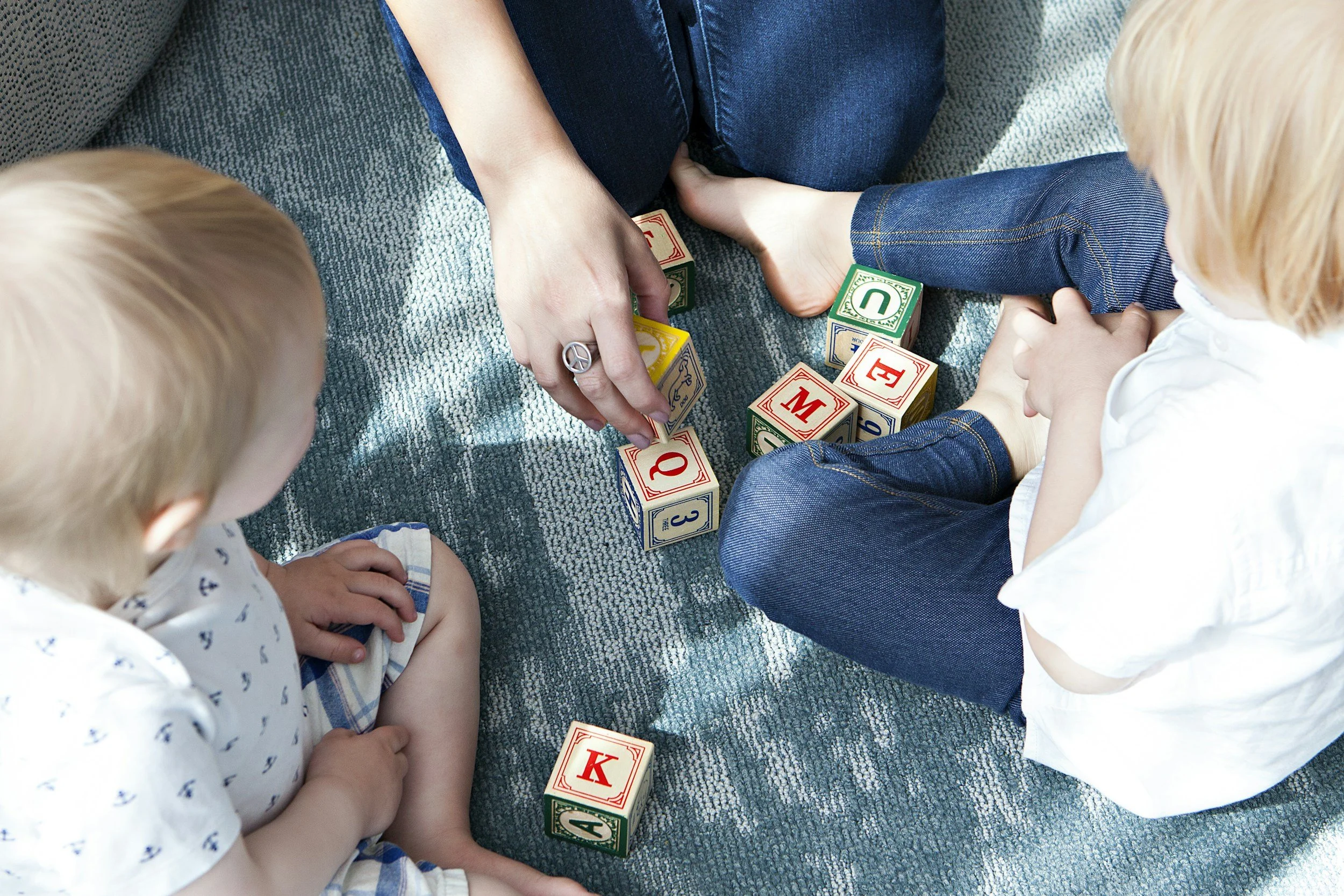
For example, building with blocks can involve spatial reasoning, planning, cooperation, and problem-solving. Story time can strengthen vocabulary and listening skills. A group activity can help children practice taking turns and communicating.
The goal is not to turn preschool into elementary school early. It is to create developmentally appropriate experiences that make learning a natural part of a child’s day.
What Should Parents Look for During a Center Visit?
Parents visiting a daycare or early learning center should look for engaged teachers, developmentally appropriate activities, organized classrooms, positive interactions, clear routines, and evidence that children have meaningful opportunities to explore. The environment should help you understand what your child will actually experience after you leave each morning.
Look beyond attractive decorations. Consider questions such as:
Are teachers actively interacting with children?
Do activities appear appropriate for the children’s ages?
Are children given opportunities to make choices and explore?
How are transitions, meals, naps, and outdoor time handled?
How does the program approach early literacy, math, science, art, and movement?
How are social-emotional skills encouraged?
How will teachers communicate with your family?
How does the curriculum change as children progress toward Pre-K?
For parents comparing options around Norwood, Westwood, Walpole, or Dedham, asking the same questions at each visit can make differences between programs much easier to recognize.
What Are Signs of a Strong Early Learning Environment?
Signs of a strong early learning environment include responsive teachers, purposeful activities, age-appropriate materials, predictable routines, positive relationships, and opportunities for children to develop socially, emotionally, physically, and cognitively. Parents should be able to see how everyday classroom experiences contribute to development.
Specific signs to watch for include:
Teachers talk and listen to children rather than primarily directing them.
Children have access to hands-on, age-appropriate materials.
The daily schedule balances active play with quieter experiences and rest.
Books, art, language, movement, and exploration are part of the environment.
Teachers can explain why particular classroom activities are being used.
Children receive opportunities to practice independence.
Families receive meaningful information about their child’s day.
Curriculum and expectations change appropriately as children develop.
No single activity defines a quality program. The overall pattern of interactions and experiences matters more.
How Does Family Communication Fit Into Early Learning?
Family communication is an important part of early learning because parents and teachers can better support a child when information flows consistently between home and the classroom. Communication can cover daily routines as well as developmental progress, classroom experiences, emerging interests, and concerns that deserve attention.
We use Brightwheel to help keep families connected with updates, photos, messaging, attendance information, and progress communication.
That connection can be particularly valuable for busy Norfolk County families. Instead of wondering what happened between morning drop-off and evening pickup, parents can have a clearer window into their child’s experiences.
Communication also gives teachers useful context. Changes at home, emerging interests, or new developmental milestones can help educators understand and support each child as an individual.
What Common Mistakes Do Parents Make When Comparing Programs?
A common mistake when comparing daycare and early learning programs is relying too heavily on the program’s label instead of examining what actually happens in its classrooms. Parents will usually learn more by asking about teachers, curriculum, daily routines, communication, developmental expectations, and classroom experiences.
Mistake: Choosing based only on convenience.
Consequence: A location may fit the commute but not provide the environment or educational approach the family wants.
Better approach: Consider logistics and program quality together.
Mistake: Assuming “academic” automatically means better.
Consequence: Parents may overlook the importance of play, movement, relationships, and social-emotional development.
Better approach: Look for developmentally appropriate, whole-child learning.
Mistake: Comparing tuition without comparing what is included.
Consequence: Two programs that initially appear similar may provide different schedules, activities, communication, or enrichment.
Better approach: Compare the complete experience.
Mistake: Not visiting before enrolling.
Consequence: A website or brochure cannot fully communicate classroom atmosphere.
Better approach: Tour the program and ask specific questions.
What Is a Common Child Care Scenario in Norwood?
A common Norwood child care scenario is a family that initially searches for dependable weekday coverage but realizes during the comparison process that curriculum and kindergarten preparation matter too. Once parents begin touring centers, their question often changes from “Who can care for my child?” to “How will my child spend these hours?”
Imagine parents commuting from Norwood toward Boston or another nearby employment center. They need reliable care that fits their workday, but their preschooler is also becoming increasingly curious, social, and independent.
A center that combines care with purposeful learning may address both priorities. The child can have a predictable daily environment while receiving opportunities to explore language, early math, science, creativity, movement, and relationships with peers.
That combination is one reason families may specifically search for an early learning center rather than treating all child care options as interchangeable.
What Early Learning Programs Can Support Different Ages?
Early learning programs can support children from infancy through Pre-K when classrooms, routines, materials, and expectations are adapted to each developmental stage. Infants need responsive care and sensory experiences, while toddlers, preschoolers, and Pre-K children benefit from increasingly complex opportunities for language, independence, cooperation, problem-solving, and school readiness.
Our programs support infants and toddlers, preschool children, and Pre-K learners. Our classrooms emphasize hands-on learning, and enrichment experiences can add opportunities involving areas such as music, science, and movement.
The approach should evolve as children grow rather than expecting every age group to learn in the same way.
Explore our early learning programs
How Should Parents Compare Daycare and Early Learning Center Options?
Parents should compare daycare and early learning center options based on the actual quality of care, curriculum, teacher interactions, communication, schedule, and developmental approach rather than the name on the building. A structured comparison helps families identify which program best matches both practical needs and their goals for their child.
Consideration Daycare-Focused Option Early Learning Center Primary emphasis Care and daily routines may be central Care plus intentional developmental learning Play May provide supervised play Often connects play with learning goals Curriculum Varies significantly Typically more explicitly structured School readiness Varies by program Often incorporated into preschool and Pre-K Family communication Varies Often integrated into the educational approach Best choice Depends on the individual center and family Depends on the individual center and family
Neither label should replace a tour and careful evaluation.
Which Areas Can Families Consider Kinderbook From?
Families looking for early learning in Norwood and surrounding Massachusetts communities can consider location, commute patterns, schedule, and program fit together when choosing a center. Kinderbook has locations in Norwood and Plainville and serves families from the surrounding region.
Our Norwood center is located on Buckminster Drive, making it an option to explore for families in Norwood as well as nearby communities such as Westwood, Walpole, Dedham, Canton, and other parts of Norfolk County.
What Can Happen If Parents Choose Based Only on the Daycare Label?
Choosing child care based only on a label can cause families to miss important differences in curriculum, classroom experiences, teacher communication, and developmental priorities. The bigger risk is not choosing something called “daycare.” It is enrolling without understanding whether the program matches your child’s needs and your family’s expectations.
Changing child care later can also mean another adjustment period for a young child and another round of research and scheduling for parents.
Taking time to tour, observe, and ask detailed questions upfront can make the decision more informed.
Schedule a center visit to compare your options
FAQ
Is an early learning center the same as a daycare in Norwood, MA?
An early learning center and daycare can both provide child care in Norwood, but the terms may describe different program priorities. Early learning centers generally place explicit emphasis on curriculum and developmental learning in addition to care. Parents should still evaluate individual programs because the name itself does not establish quality or educational approach.
Does my child need an early learning center before kindergarten?
Children do not all need exactly the same early childhood setting before kindergarten, but a quality early learning environment can provide valuable opportunities to build social, communication, independence, and early academic skills. Norwood families should consider their child’s development, family schedule, classroom environment, and goals when comparing programs.
What should Norwood parents ask during an early learning center tour?
Norwood parents should ask about curriculum, teachers, daily schedules, family communication, classroom activities, safety procedures, meals and rest, outdoor play, and kindergarten preparation. Ask teachers to describe a typical day and explain how activities support development. Concrete answers can reveal much more about a center than its marketing terminology.
How is play connected to learning?
Play supports learning by giving young children opportunities to communicate, experiment, solve problems, move, imagine, cooperate, and practice emerging skills. In a purposeful early learning environment, teachers can select materials and activities that encourage development while preserving the curiosity and enjoyment that make play appropriate for young children.
What does Kinderbook offer families in Norwood?
We provide early learning programs for children from infancy through Pre-K at our Norwood location. Our approach combines nurturing care, purposeful play, hands-on classroom experiences, and lessons guided by Massachusetts Early Learning Guidelines. We also use Brightwheel for family communication and provide enrichment opportunities that complement classroom learning.
Can an early learning center help with kindergarten readiness?
An early learning center can support kindergarten readiness by developing more than early academic skills. Children can practice listening, communicating, following routines, working with others, solving problems, developing independence, and approaching new experiences with confidence. For Norwood families, asking how a Pre-K program supports these areas can help when comparing centers.
What ages can attend Kinderbook?
Our programs serve children beginning in infancy and continue through toddler, preschool, and Pre-K stages. Each developmental period requires a different classroom approach, so activities and expectations change as children grow. Families in Norwood can tour the appropriate classroom to learn more about the experiences planned for their child’s age group.
Should families from nearby Norfolk County communities consider a Norwood center?
Families from nearby Norfolk County communities can consider a Norwood center when its location, schedule, curriculum, and classroom environment work well for their routines. Parents in communities such as Westwood, Walpole, Dedham, and Canton may find it useful to compare both commuting convenience and the educational experience their child will receive.
Give Your Child a Purposeful Start in Norwood
Choosing between daycare and an early learning center becomes easier once you look beyond the terminology. The right questions focus on what children experience each day, how teachers support their development, and whether the program feels like a good fit for the whole family.
At Kinderbook, we help children learn through caring relationships, purposeful play, exploration, and age-appropriate experiences designed to support growth from infancy through Pre-K.
