
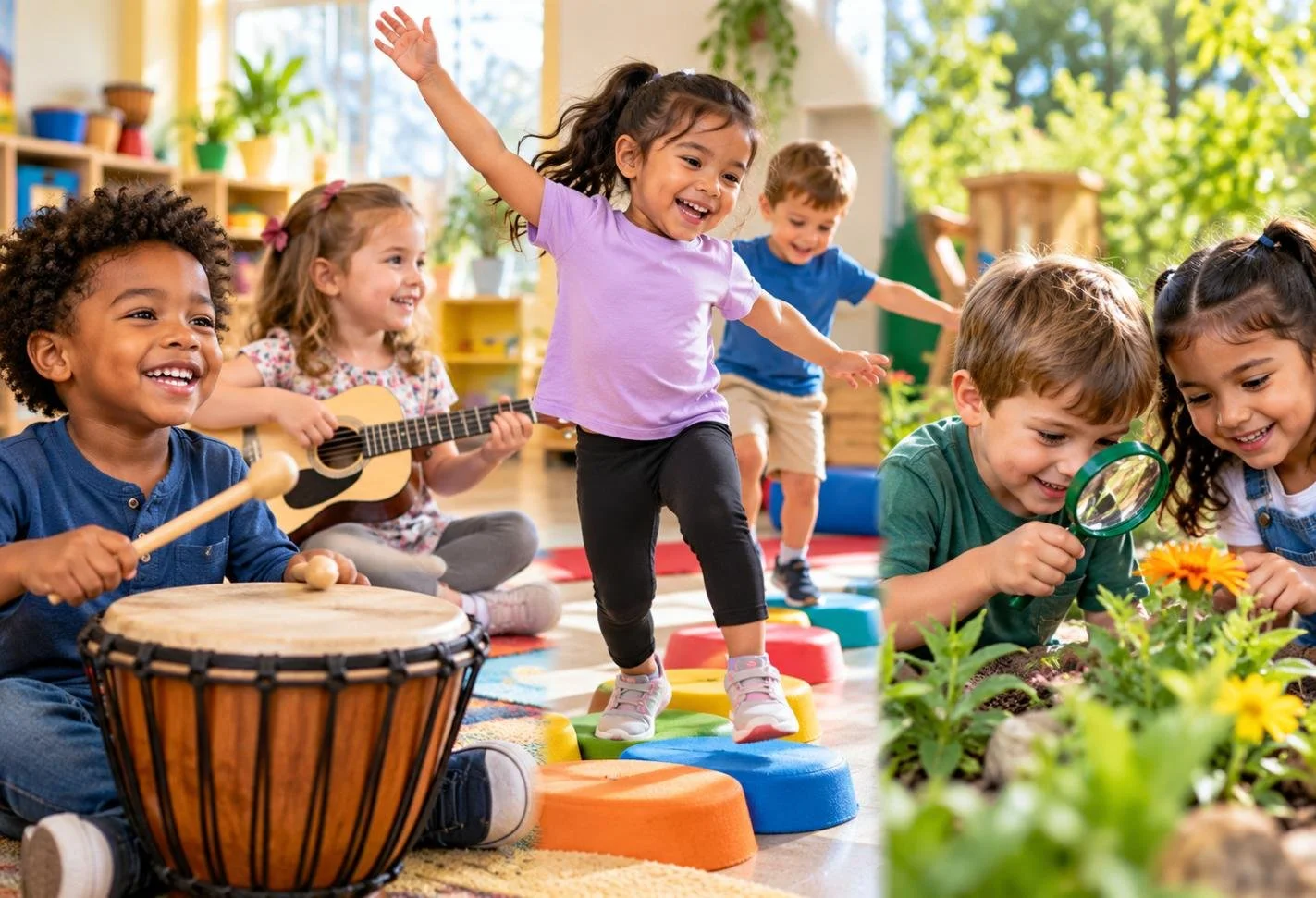
For families in Norwood and Plainville, Massachusetts, choosing an early learning center involves more than finding a safe place for their children during the workday. Parents want an environment where their children can build confidence, develop friendships, express creativity, and discover the world around them.
Music, movement, and nature exploration help make those experiences possible. When thoughtfully integrated into early childhood education, these enrichment activities support children's physical, emotional, social, and cognitive development while making learning engaging and meaningful.
How Enrichment Programs Support Whole-Child Development
Enrichment programs support whole-child development by giving young children opportunities to strengthen multiple developmental skills through play, exploration, and hands-on learning. In Norwood and Plainville early learning centers, music, movement, and nature-based activities can complement classroom instruction while helping children develop communication, coordination, creativity, and social connections.
Whole-child development recognizes that children grow in several interconnected areas:
Cognitive development: Music patterns, sensory exploration, and creative activities encourage problem-solving, memory, and early reasoning skills.
Physical development: Dancing, stretching, outdoor play, and movement games strengthen balance, coordination, and motor skills.
Social development: Group songs, cooperative games, and shared discoveries help children practice communication, teamwork, and friendship.
Emotional development: Creative expression and active play provide opportunities to recognize feelings, build confidence, and practice self-regulation.
Language development: Songs, storytelling, rhythm, and conversations about nature introduce vocabulary and strengthen listening skills.
For families throughout Norfolk County, these experiences can help create a well-rounded foundation for kindergarten and continued learning.
At Kinderbook, Inc., we understand the value of looking beyond academic milestones when considering a child's early education. Enrichment experiences can be an important part of helping young learners grow across developmental areas.
Why Music Enrichment Matters in Early Childhood Education
Music enrichment strengthens early childhood development by combining rhythm, language, memory, emotional expression, and social interaction into engaging learning experiences. For young children in Norwood and Plainville, singing, listening, and experimenting with sounds can introduce important skills before formal academic instruction begins.
Music offers several developmental benefits.
Language and Early Literacy Skills
Nursery rhymes, repetitive songs, and rhythmic activities help children recognize sounds and patterns in spoken language.
Clapping along to syllables or singing familiar verses can support phonological awareness, an early literacy skill that helps children understand how words are made of sounds.
Memory and Concentration
Remembering song lyrics, anticipating musical changes, and following simple rhythmic patterns give children opportunities to practice attention and recall.
For example, a preschooler who follows a song with changing instructions must listen, remember what comes next, and respond appropriately.
Emotional Expression
Music provides children with another way to communicate feelings.
An energetic song may encourage excitement and movement, while a gentle melody can support a calming classroom transition.
Cooperation and Social Skills
Group singing and simple instrument activities encourage children to listen to one another, take turns, and participate in shared experiences.
For parents evaluating preschool enrichment programs in Norfolk County, music is worth considering because it supports learning through activities children naturally enjoy.
How Movement Activities Strengthen Physical and Cognitive Growth
Movement activities support physical and cognitive development by helping young children practice coordination, balance, body awareness, attention, and self-control. In early learning environments throughout Plainville and Norwood, active play gives children opportunities to develop foundational motor skills while learning to follow directions and interact with peers.
Movement enrichment can include dancing, obstacle courses, stretching, balancing games, and imaginative physical play.
Building Gross Motor Skills
Running, hopping, jumping, and climbing help children develop large muscle groups.
These abilities contribute to everyday independence, including navigating playgrounds, participating in group games, and managing physical classroom activities.
Supporting Focus and Following Directions
Movement games often involve listening and responding to instructions.
Activities such as freeze dancing or copying a sequence of movements encourage children to pay attention, remember directions, and adjust their actions.
Developing Confidence
When children learn a new movement or complete an age-appropriate physical challenge, they experience a sense of accomplishment.
These small successes can encourage persistence and willingness to try unfamiliar activities.
Encouraging Positive Social Interaction
Partner games, group dances, and cooperative obstacle courses provide opportunities to practice patience, turn-taking, and teamwork.
For local families balancing indoor learning with active play, movement enrichment helps ensure that physical development remains part of the early education experience.
Why Nature Exploration Is Valuable for Young Learners
Nature exploration supports whole-child development by encouraging curiosity, sensory learning, observation, physical activity, and environmental awareness. Children in Norwood and Plainville can benefit from age-appropriate outdoor experiences that introduce seasonal changes, living things, and natural materials through direct observation.
Massachusetts offers distinct seasonal learning opportunities that can make nature exploration especially meaningful.
Spring: Discovering Growth and Change
As temperatures become milder, children can observe emerging leaves, flowers, insects, and changing weather.
Activities such as planting seeds or comparing different leaves introduce early science concepts.
Summer: Exploring Through the Senses
Warm-weather activities may include examining natural textures, observing shadows, and exploring water or sand under appropriate supervision.
These experiences encourage descriptive language and sensory awareness.
Fall: Learning About Patterns and Seasons
Autumn in Norfolk County provides opportunities to observe colorful leaves, changing temperatures, and seasonal changes in plants.
Children can sort leaves by size, compare colors, and collect safe natural materials for classroom activities.
Winter: Observing Weather and the Environment
Even when outdoor activities are limited by cold conditions, children can investigate snow, ice, winter clothing, and changes in daylight.
Short, weather-appropriate outdoor experiences and indoor nature activities can keep exploration part of the learning process.
Nearby natural spaces, including the Francis William Bird Park area in Walpole and the broader conservation landscapes of southeastern Massachusetts, also illustrate the types of environments that make local nature learning relevant to families.
Signs an Early Learning Program Supports Whole-Child Growth
A strong whole-child learning environment provides regular opportunities for creative expression, physical activity, social interaction, exploration, and developmentally appropriate challenges. Parents visiting early learning centers in Norwood or Plainville can look for practical signs that enrichment is integrated into children's experiences.
Consider these indicators:
Children have opportunities to explore music. Songs, rhythms, and age-appropriate instruments are used for creativity and learning.
Physical movement is part of the routine. Children have opportunities for active play rather than remaining seated for extended periods.
Outdoor discovery is encouraged. Teachers use appropriate weather conditions and natural materials to support exploration.
Activities accommodate different developmental stages. Children can participate according to their abilities and comfort levels.
Social interaction is supported. Group activities encourage cooperation, communication, and turn-taking.
Creative expression is valued. Children have opportunities to experiment rather than focus exclusively on producing identical results.
Teachers connect play with learning. Activities have developmental value while remaining enjoyable and child-centered.
Parents should also ask how enrichment activities are adapted for toddlers, preschoolers, and children preparing for kindergarten.
How Enrichment Programs Help Children Prepare for Kindergarten
Enrichment programs help children prepare for kindergarten by strengthening independence, communication, attention, social confidence, and early problem-solving skills. For families in the Norwood Public Schools and Plainville Public Schools communities, these abilities complement early literacy and numeracy as children approach the transition into elementary education.
Kindergarten readiness extends beyond recognizing letters and counting numbers.
Children also benefit from learning how to:
Listen and respond to instructions during group activities.
Communicate their needs and ideas.
Work cooperatively with other children.
Manage transitions between activities.
Approach unfamiliar challenges with curiosity.
Develop confidence in their physical abilities.
Music supports listening and pattern recognition. Movement activities help children practice following directions and managing their bodies in shared spaces. Nature exploration encourages questioning, observation, and flexible thinking.
Together, these experiences contribute to the broader skills children use in kindergarten classrooms.
Common Mistakes Parents Make When Evaluating Enrichment Programs
The most common mistakes when evaluating enrichment programs involve focusing on activity names rather than developmental value, age appropriateness, and consistency. Parents comparing early learning options around Norwood, Plainville, Walpole, and Foxborough can make more informed decisions by understanding how activities are actually delivered.
Mistake 1: Assuming More Activities Always Mean Better Learning
A long list of enrichment offerings does not automatically indicate a stronger program.
Better approach: Ask how activities connect to developmental goals and whether children have enough time for meaningful participation.
Mistake 2: Prioritizing Academics Over Active Play
Early literacy and math matter, but young children also need opportunities to move, create, and interact.
Better approach: Look for a balanced approach that supports academic foundations alongside physical, social, and emotional growth.
Mistake 3: Overlooking Individual Developmental Needs
Children develop at different rates and may respond differently to music, movement, or sensory experiences.
Better approach: Ask how teachers adapt activities for different abilities, interests, and comfort levels.
Mistake 4: Treating Outdoor Time as Separate From Learning
Outdoor play can offer opportunities for observation, language development, cooperation, and scientific curiosity.
Better approach: Ask how nature experiences are connected to classroom discussions and hands-on discovery.
A Common Local Scenario: A Preschooler Building Confidence Through Enrichment
A common enrichment scenario involves a preschooler who initially hesitates during group activities but gradually becomes more comfortable through repeated, supportive experiences. This illustrates how music, movement, and nature exploration can reinforce one another in a local early learning setting.
Imagine a child attending a preschool program in Plainville who enjoys observing classmates but rarely volunteers during group activities.
During music time, the child begins participating by clapping along to familiar songs. In movement activities, the child starts copying simple dance steps alongside a trusted classmate.
Later, during an outdoor nature activity, the child becomes excited about discovering different leaf shapes and shares observations with the group.
These experiences create different opportunities for participation without requiring the child to demonstrate confidence in exactly the same way every time.
While every child's progress is individual, varied enrichment experiences can help teachers support different strengths and learning styles.
Choosing Between Basic Childcare and Enrichment-Focused Early Learning
The most useful comparison is not simply basic childcare versus enrichment-focused learning, but how well each program combines safety, responsive care, developmentally appropriate instruction, and meaningful play. Families in the Norwood and Plainville area should evaluate the actual daily experience rather than rely only on program descriptions.
What to compareQuestions to askMusicAre songs, rhythms, and creative musical experiences part of learning?MovementDo children have regular opportunities for active, age-appropriate physical play?NatureAre outdoor exploration and seasonal observations encouraged?Social developmentHow do teachers support cooperation, friendships, and emotional expression?Kindergarten readinessHow are independence, language, and early academic skills developed together?Individual needsHow are activities adjusted for different developmental stages?
A thoughtful program should make enrichment accessible and purposeful without placing unnecessary pressure on children to perform.
How Families Can Reinforce Enrichment Learning at Home
Families can reinforce enrichment learning through simple, consistent activities that encourage creativity, movement, conversation, and curiosity. Parents in Norwood, Plainville, and nearby Norfolk County communities do not need expensive equipment or elaborate schedules to extend developmental learning beyond the classroom.
Try incorporating these experiences into family routines:
Sing during everyday activities. Use familiar songs while getting dressed, cleaning up, or traveling.
Create movement games. Play freeze dance or practice hopping and balancing in a safe space.
Take neighborhood nature walks. Look for seasonal changes, birds, trees, and different leaf shapes.
Ask open-ended questions. Encourage children to describe what they hear, notice, and feel.
Use simple household instruments. Explore rhythm with safe, age-appropriate objects.
Encourage child-led exploration. Allow time for children to investigate their interests.
During colder Massachusetts months, indoor movement games, music sessions, and nature-inspired crafts can provide alternatives when outdoor conditions are unsuitable.
Consistency and positive interaction matter more than the complexity of the activity.
Early Learning Opportunities for Norwood, Plainville, and Nearby Families
Families in Norwood and Plainville can evaluate early learning opportunities by considering developmental philosophy, enrichment experiences, classroom environment, and practical family needs. Nearby communities such as Walpole, Norfolk, Wrentham, and Foxborough also provide useful geographic context when comparing childcare and preschool options.
Commute time, scheduling, age-group availability, and communication with educators can all influence whether a program fits a family's routine.
At Kinderbook, Inc., we encourage families to ask thoughtful questions about how early learning experiences support the whole child.
Explore our early learning programs
The Long-Term Value of Whole-Child Enrichment
Whole-child enrichment can support long-term learning by helping children build foundational skills that extend beyond preschool. When young learners have opportunities to communicate, cooperate, move confidently, and explore their surroundings, they practice abilities that remain relevant throughout their education.
Without varied learning experiences, children may have fewer opportunities within their daily program to discover interests or practice skills outside structured academic activities.
That does not mean every child needs a packed enrichment schedule. Unstructured play, rest, responsive relationships, and age-appropriate routines are equally valuable.
The goal is a balanced early learning experience that supports development without overwhelming children.
Ask about enrichment opportunities for your child
Frequently Asked Questions About Early Learning Enrichment in Norwood and Plainville
1. What are enrichment programs in early childhood education?
Enrichment programs are activities that expand children's learning through creative, physical, social, and hands-on experiences. Common examples include music, movement, art, and nature exploration. In early learning centers, these activities can complement classroom instruction while helping children develop communication, coordination, confidence, and curiosity.
2. How does music help preschoolers in Norwood develop early literacy skills?
Music helps preschoolers develop early literacy skills through rhymes, repetition, rhythm, and sound recognition. Singing and clapping to syllables can strengthen phonological awareness, while familiar songs encourage listening and vocabulary development. These activities provide playful opportunities to practice skills associated with later reading and language learning.
3. Why is movement important for toddlers and preschoolers in Plainville?
Movement is important because toddlers and preschoolers are developing coordination, balance, strength, and body awareness. Dancing, jumping, stretching, and active games also create opportunities to follow instructions and cooperate with others. Age-appropriate movement helps children practice physical skills while supporting confidence and engagement.
4. Can nature exploration benefit children during Massachusetts winters?
Yes. Nature exploration can continue during Massachusetts winters through safe outdoor observations and indoor learning activities. Children can examine snow, discuss weather patterns, observe bare trees, and investigate seasonal changes. Outdoor participation should account for temperatures, weather conditions, suitable clothing, and each child's developmental needs.
5. How do enrichment activities support social-emotional development?
Enrichment activities support social-emotional development by creating opportunities for cooperation, expression, patience, and shared experiences. Group songs encourage participation, movement games promote turn-taking, and nature activities invite collaborative discovery. Supportive teachers can help children recognize feelings, communicate needs, and build positive relationships during these experiences.
6. What should Norwood parents ask when touring an early learning center?
Norwood parents should ask how music, movement, outdoor play, and creative exploration fit into the daily schedule. It is also helpful to ask how teachers adapt activities for different ages, support emotional development, and communicate children's progress. Observing classroom interactions can provide valuable insight into the learning environment.
7. Do enrichment programs help children prepare for kindergarten in Plainville?
Yes. Enrichment programs can help children prepare for kindergarten by supporting listening, communication, independence, cooperation, and problem-solving. Music encourages pattern recognition, movement activities develop self-control, and nature exploration promotes observation. These experiences complement early academic learning and support skills used in elementary classrooms.
8. How often should preschool children participate in enrichment activities?
Preschool children generally benefit from regular, age-appropriate opportunities for music, movement, creative play, and exploration. The ideal schedule varies according to developmental needs, activity intensity, and classroom routines. Families should look for a balanced approach that includes active learning, free play, quiet time, and rest.
9. How can families in Norfolk County support whole-child development outside preschool?
Families in Norfolk County can support whole-child development by singing together, visiting outdoor spaces, playing movement games, reading stories, and encouraging curiosity. Everyday activities such as cooking, sorting natural objects, and discussing seasonal changes can also create meaningful learning opportunities without requiring specialized equipment or formal lessons.
Help Your Child Grow Through Meaningful Early Learning Experiences
Music, movement, and nature exploration offer more than enjoyable activities. They create opportunities for children to build confidence, develop important skills, and discover new interests during their earliest years.
For families in Norwood and Plainville, choosing an early learning environment that values the whole child can help establish a positive foundation for future learning.
At Kinderbook, Inc., we recognize how meaningful these early developmental experiences can be for children and families.
Give Your Child a Strong Foundation for Learning and Growth
Explore early childhood education options that prioritize curiosity, creativity, confidence, and developmentally appropriate learning.
